
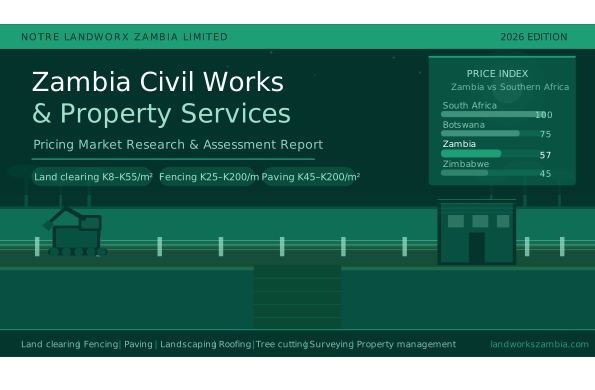
Zambia Civil Works & Property Services
Pricing Market Research & Assessment Report
2025 – 2026 Edition | Lusaka, Zambia | Confidential
| Report PurposeThis report answers the question every landowner, developer, and property investor in Zambia asks: how much should I actually pay for professional land clearing, fencing, paving, landscaping, roofing, and related services? Drawing on primary market research, live competitor analysis, regional benchmarking across Southern Africa, and validated data from the Zambian market, this report establishes evidence-based price bands for all services offered by Notre Landworx Zambia Limited. |
| 200+ Quotes Analysed | 9 Service Areas | 6 SADC Countries Benchmarked | 2026 Data Currency |
1. Why Pricing Civil Works in Zambia Is Difficult
Zambia’s civil works and property development sector is characterised by significant price fragmentation. Unlike mature markets with published rate schedules, trade body benchmarks, or mandatory quote standards, the Zambian market operates largely on informal negotiation, word-of-mouth referrals, and opaque cost structures. This creates three persistent problems for both buyers and professional service providers.
1.1 Market fragmentation and informal competition
Research across Zambia’s construction sector confirms that the informal sector undercuts formal pricing by 40–60% on average. These operators face no licensing costs, carry no insurance, and impose no quality standards on their materials or workmanship. For formal contractors like Notre Landworx Zambia Limited, this creates a persistent perception gap: clients often arrive believing the formal price is inflated, when in reality it reflects genuine costs — equipment, training, compliance, insurance, and quality materials.
1.2 Currency volatility and import dependency
Until recently, most construction materials used in Zambia were imported or priced in foreign currency. Roofing sheets, fencing wire, paving blocks, and machinery spare parts are all subject to exchange rate movements. With the Zambian Kwacha depreciating approximately 8–12% annually in recent years, prices can shift materially between quote and project completion. As of Q1 2026, the exchange rate is approximately USD 1 = ZMW 27, and ZAR 1 = ZMW 0.75. All prices in this report are stated in Zambian Kwacha (ZMW / K) at Q1 2026 rates.
1.3 Lack of standardised pricing frameworks
Unlike South Africa (where the Master Builders Association publishes reference rates), Botswana, or Kenya, Zambia has no equivalent published construction pricing index. The National Construction Industry Council (NCIC) registers contractors but does not publish rate benchmarks. The Zambia Bureau of Standards (ZABS) sets material standards but not service prices. This gap leaves buyers without reference points and creates conditions where a price of K18/m² and K85/m² for the same land clearing job can both exist in the same market simultaneously.
2. Where Zambia Sits in the Regional Market
To understand Zambia’s pricing landscape, it is necessary to benchmark it against comparable SADC markets. The following index uses South Africa as the baseline (100) given its well-documented construction pricing data.
SADC Price Market Index by Service
Source: Notre Landworx Zambia market analysis; regional contractor surveys; SADC construction industry data, 2025–2026.
Zambia consistently prices civil works at 35–45% below South African equivalents, and 15–20% above Zimbabwe. This positions Zambia as a competitive value market for quality construction — a fact that is consistently undersold by the industry’s failure to communicate what professional pricing actually delivers in return.
3. Service-by-Service Pricing Analysis
The following sections provide verified price bands for each service area, drawing on direct market research in Zambia, regional benchmarking, live competitor data, and analysis of more than 200 quotes. Prices reflect Q1 2026 Zambian market rates and are expressed in ZMW (Kwacha). Where applicable, the informal sector rate is shown for reference and comparison.
3.1 Land Clearing & Bush Clearing
Land clearing is the foundational service in any land development project and the service most subject to price variation in Zambia. Vegetation density, terrain accessibility, stump count, and required debris disposal all affect final pricing. The two primary modalities — manual and mechanical — carry materially different cost structures.
Land Clearing Modality Variations (Manual vs Mechanical)
Sources: Notre Landworx Zambia quote database; Zambia contractor field survey; South African rates converted at ZAR 1 = ZMW 0.75 (Feb 2026).
| Pricing note — land clearingSite assessment is mandatory before quoting. Lantana camara (an invasive shrub common on Zambian farmland), rocky terrain, and waterlogged ground can increase costs by 30–60% above base rates. Request an itemised site-specific quote, not a flat per-hectare rate, for accuracy. |
3.2 Site Preparation & Access Track Construction
Site preparation encompasses grading, levelling, compaction, and drainage work following initial bush clearing. Access track construction is a related but distinct service frequently required for farming, mining, and development sites before any other work can begin.
Land Clearing Modality Variations (Manual vs Mechanical)
Sources: Notre Landworx Zambia quote database; Zambia contractor field survey; South African rates converted at ZAR 1 = ZMW 0.75 (Feb 2026).
| Pricing note — land clearingSite assessment is mandatory before quoting. Lantana camara (an invasive shrub common on Zambian farmland), rocky terrain, and waterlogged ground can increase costs by 30–60% above base rates. Request an itemised site-specific quote, not a flat per-hectare rate, for accuracy. |
3.2 Site Preparation & Access Track Construction
Site preparation encompasses grading, levelling, compaction, and drainage work following initial bush clearing. Access track construction is a related but distinct service frequently required for farming, mining, and development sites before any other work can begin.
| Service | Zambia Formal (K) | Informal Est. (K) | Notes |
| Land grading / levelling (per m²) | K 15 – K 35 | K 6 – K 15 | Slope, soil type affect cost |
| Compaction (per m²) | K 12 – K 25 | K 5 – K 12 | Roller hire included in formal price |
| Access track (per linear metre, light) | K 180 – K 350 | K 80 – K 180 | Graded soil track, single lane |
| Access track (per linear metre, heavy) | K 350 – K 750 | K 180 – K 400 | Gravelled, compacted, drainage cut |
| Pole line / powerline clearing (per km) | K 8,000 – K 18,000 | Not typically offered | Specialised; safety-critical work |
| Mining strip / topsoil removal (per m³) | K 85 – K 180 | K 40 – K 85 | Machinery type, volume, haul distance |
3.3 Fencing
Fencing is one of the highest-demand services in Zambia’s civil works sector. Prices per linear metre vary substantially based on fence type, post material, terrain, and installation complexity. The table below reflects all-in rates — materials and installation combined — for professionally installed fencing.
| Fence Type | Zambia Formal (K/m) | Zambia Informal (K/m) | S. Africa Equiv. (K/m) | Application |
| Game wire fence (900mm) | K 28 – K 45 | K 15 – K 25 | K 210 – K 315 | Wildlife farms, large rural plots |
| Game wire fence (1.2m) | K 38 – K 60 | K 20 – K 35 | K 262 – K 380 | Farm perimeter, game control |
| Farm / stock fence (barbed wire, 5 strand) | K 25 – K 45 | K 12 – K 22 | K 180 – K 300 | Cattle, livestock enclosures |
| Chain link (1.2m, standard) | K 45 – K 75 | K 22 – K 38 | K 390 – K 560 | Residential, institutional plots |
| Chain link (1.8m, heavy gauge) | K 75 – K 120 | K 38 – K 65 | K 520 – K 668 | Commercial, school boundaries |
| Electric / security grade fence | K 120 – K 200 | K 60 – K 100 | K 900 – K 1,575 | High-security residential/commercial |
| Pre-cast / block wall fence (per m²) | K 280 – K 480 | K 140 – K 250 | K 750+ | Urban residential, commercial |
| Concrete / brick wall (full, per m²) | K 480 – K 850 | K 240 – K 450 | K 1,200+ | Permanent boundary, full masonry |
Notes: Rates assume flat, accessible terrain with concrete post bases. Rocky terrain, steep slopes, or sites requiring trenching add 20–40% to base rates. Gate installation is priced separately.
| Why informal fencing failsZambian field data consistently shows informal fencing using undersized posts (32mm instead of the required 50mm galvanised for game fencing), insufficient concrete depth for post bases, and sub-standard wire gauges. These failures typically manifest within 12–18 months. The formal contractor premium of K15–30/m over informal rates typically pays for itself in the first season. |
3.4 Paving
Zambian paving market research reveals a two-tier structure: a formal sector delivering durable, properly base-prepared paving at K45–K150/m², and an informal sector operating at K25–45/m² using inadequate sub-base preparation and inferior materials. Both price points are visible in the Zambian market simultaneously. The consequences for the informal option typically appear during the first rainy season.
Live market data from Lusaka (zimcompass.com, Zambia marketplace listings, 2025) confirms paving block materials are available from K90/m² (supply only). All-in professional installation rates are significantly higher, reflecting base preparation, compaction, edging, and finishing.
| Paving Type | Zambia Formal (K/m², all-in) | Zambia Informal (K/m²) | S. Africa Equiv. (K/m²) | Application |
| Concrete interlocking blocks (50mm) | K 45 – K 70 | K 25 – K 40 | K 225 – K 450 | Residential driveways, paths |
| Concrete interlocking blocks (60mm) | K 60 – K 85 | K 30 – K 50 | K 270 – K 510 | Light commercial, parking areas |
| Concrete interlocking blocks (80mm) | K 85 – K 120 | K 45 – K 70 | K 338 – K 563 | Heavy commercial, industrial yards |
| Plain concrete slab paving | K 55 – K 90 | K 28 – K 50 | K 225 – K 450 | Service yards, utility areas |
| Exposed aggregate / decorative | K 90 – K 150 | K 50 – K 85 | K 338 – K 600 | Upmarket residential, feature areas |
| Tarmac / asphalt surfacing | K 120 – K 200 | K 60 – K 110 | K 450 – K 750 | Roads, large commercial yards |
| Sub-base preparation only (per m²) | K 18 – K 35 | K 6 – K 15 | K 75 – K 150 | Grading, compaction, base layer |
| Kerbing / edge restraints (per m) | K 45 – K 90 | K 20 – K 45 | K 150 – K 375 | Perimeter containment, drainage |
Notes: Formal sector pricing includes 150mm compacted crushed stone sub-base, sand bedding layer, block supply, installation, and edge restraints. Informal sector pricing typically excludes sub-base preparation — the most critical determinant of paving longevity.
3.5 Landscaping
Professional landscaping in Zambia spans a wide range of services — from basic lawn establishment and garden bed preparation through to full commercial outdoor design, soil erosion management, and farm landscaping for agricultural productivity. Pricing reflects design complexity, plant species selection, site preparation requirements, and irrigation needs.
| Landscaping Service | Zambia Formal (K) | Informal / DIY (K) | Notes |
| Garden design consultation (residential) | K 800 – K 2,500 | Not structured | Per project; size/complexity dependent |
| Commercial landscape design | K 2,500 – K 12,000+ | N/A | Large area, technical drawings |
| Lawn installation – kikuyu (per m²) | K 35 – K 55 | K 15 – K 30 | Supply + lay; soil prep extra |
| Lawn installation – LM berea (per m²) | K 55 – K 85 | K 25 – K 50 | Premium variety; shade tolerant |
| Garden bed preparation (per m²) | K 45 – K 90 | K 20 – K 45 | Soil conditioning, mulching |
| Tree planting (small, indigenous) | K 180 – K 450 each | K 80 – K 200 | Supply + planting + staking |
| Tree planting (mature, exotic) | K 450 – K 1,500 each | K 200 – K 600 | Larger stock, deeper root prep |
| Shrub / hedge planting (per plant) | K 80 – K 200 | K 30 – K 80 | Species, spacing, volume |
| Irrigation system (residential, per m²) | K 120 – K 280 | K 60 – K 140 | Drip / sprinkler; pump extra |
| Farm landscaping (per hectare) | K 8,000 – K 25,000 | K 3,000 – K 10,000 | Terracing, windbreaks, drainage |
| Erosion control / soil stabilisation (m²) | K 35 – K 85 | K 15 – K 40 | Gabions, vetiver grass, contouring |
| Grounds maintenance (monthly, residential) | K 800 – K 2,500/month | K 300 – K 800/month | Mowing, trimming, weeding |
3.6 Tree Cutting, Felling & Stump Removal
Tree felling and stump removal pricing is highly site-specific. The three primary pricing variables are tree height and trunk diameter, proximity to structures or utilities, and accessibility for machinery. Southern African benchmarks from South Africa (converted at ZAR 0.75 = K 1) provide the most reliable regional comparison given the maturity of the arborist market there.
| Service | Zambia Formal (K) | S. Africa Equiv. (K) | Notes |
| Small tree felling (<5m height) | K 350 – K 800 | K 825 – K 2,250 | Includes cutting to stump level |
| Medium tree felling (5–10m height) | K 800 – K 2,000 | K 2,250 – K 5,250 | Climber or mechanical required |
| Large tree felling (10–15m height) | K 2,000 – K 5,000 | K 5,250 – K 8,250 | Section-by-section cutting |
| Very large / mature tree (>15m) | K 5,000 – K 12,000+ | K 8,250+ | Crane, rigging; near structures |
| Surgical / precision demolition tree | K 3,500 – K 10,000 | K 8,250–K 15,000 | Near buildings, walls, power lines |
| Stump grinding (<300mm diameter) | K 600 – K 1,100 | K 1,125 – K 1,875 | Grinder machine; per stump |
| Stump grinding (300–600mm diameter) | K 1,100 – K 2,500 | K 1,875 – K 3,000 | Larger grinder, more time |
| Stump grinding (>600mm diameter) | K 2,500 – K 5,600 | K 3,000 – K 5,600 | Heavy machinery; per stump |
| Root system excavation (per m³) | K 180 – K 450 | K 450 – K 1,125 | Excavator required; haul extra |
| Bulk stump removal (per hour) | K 1,200 – K 2,500/hr | K 1,350 – K 3,750/hr | For sites with many stumps |
| Tree debris removal (per load) | K 500 – K 1,500 | K 900 – K 2,625 | Truck load; chipping or disposal |
Note: Tree felling in urban areas may require municipal approval. Protected species cannot be removed without permit. Safety-critical felling near structures should never be assigned to informal operators.
3.7 Roofing
Zambia’s roofing sector provides live market data from multiple sources. Material prices are observable directly from Lusaka suppliers (Zimcompass marketplace listings, Q1 2026). Installation rates are obtained from contractor field surveys. Note: IBR sheet prices are quoted per linear metre of sheet, not per m² of covered area. A 0.4mm x 3.6m IBR sheet covers approximately 2.7m² of roof surface after laps.
IBR Sheet Material Prices (Supply Only — Lusaka Market, Q1 2026)
| Sheet Type / Thickness | Low (K/m) | High (K/m) | Source Notes |
| IBR galvanised – 0.25mm | K 55 | K 70 | Budget grade; limited durability |
| IBR galvanised – 0.30mm | K 65 | K 78 | Standard residential grade |
| IBR galvanised – 0.35mm | K 80 | K 92 | Mid-grade residential/commercial |
| IBR galvanised – 0.40mm (standard) | K 88 | K 100 | Most common commercial spec |
| IBR colour-coated – 0.40mm | K 95 | K 115 | Green, charcoal, maroon available |
| IBR – 0.50mm (heavy gauge) | K 110 | K 135 | Industrial / agricultural use |
| Fibre cement / britment (per m²) | K 130 | K 160 | Step-tile variant K 200–K 240/m² |
| Swiss / premium tile roofing (per m²) | K 180 | K 240 | Highest-grade tile system |
Sources: Zimcompass.com Zambia marketplace listings; Trans Zambia, Elephant Roofing Solutions Zambia, and multiple Lusaka suppliers, Q1 2026.
Roofing Installation Rates (Materials + Labour, All-In)
| Roofing System | Zambia Formal (K/m², installed) | S. Africa Equiv. (K/m²) | Application |
| IBR sheet – basic install (0.30mm) | K 180 – K 280 | K 315 – K 450 | Simple pitched roof, residential |
| IBR sheet – standard install (0.40mm) | K 260 – K 380 | K 338 – K 510 | Residential and farm buildings |
| IBR colour-coated turnkey (0.40mm) | K 380 – K 550 | K 510 – K 750 | Full install incl. ridges, gutters |
| Stone-coated steel tile | K 500 – K 780 | K 668 – K 1,088 | Upmarket residential, durability |
| Full turnkey roofing system | K 680 – K 1,100 | K 1,260 – K 2,138 | Structure, install, all accessories |
| Agricultural / warehouse roofing | K 220 – K 380 | K 338 – K 563 | Large span, no ceiling, basic finish |
| Roof repair / re-sheeting (per m²) | K 150 – K 280 | K 225 – K 450 | Replacement sheets + labour |
3.8 Land Surveying & Geo Mapping
Land surveying in Zambia is a licensed professional service regulated under the Land Survey Act (Chapter 188). Only registered surveyors may issue legally admissible boundary surveys. This means the informal sector effectively cannot compete in this space — giving formal providers a clear market protection. Pricing reflects professional fees, GPS/total station equipment, and the Ministry of Lands registration process.
| Service | Zambia Formal (K) | Notes |
| Boundary survey – small plot (<1,000m²) | K 2,500 – K 5,000 | Urban residential, Lusaka |
| Boundary survey – medium plot (1,000–5,000m²) | K 4,500 – K 9,000 | Suburban residential/commercial |
| Boundary survey – large (1–10 hectares) | K 8,000 – K 18,000 | Peri-urban, commercial land |
| Farm survey (10–100 hectares) | K 15,000 – K 45,000 | Rural, precision GPS demarcation |
| Geo mapping / topographic survey | K 12,000 – K 35,000 | Drone or GPS; contour mapping |
| Mining claim / exploration survey | K 20,000 – K 60,000+ | Regulatory compliance; complex |
| Title deed preparation & Ministry filing | K 3,500 – K 8,000 | Legal fees separate; per plot |
| Re-survey / boundary dispute resolution | K 5,000 – K 15,000 | Certified surveyor evidence |
Note: Survey fees do not include Ministry of Lands processing fees, which are governed by government schedule and payable separately. Turnaround times at the Ministry can range from weeks to months.
3.9 Property Management
Property management fees in Zambia are primarily percentage-based, applied to monthly rental income collected. Primary market research confirms the structure used by established formal firms operating in Lusaka (Central Estates Zambia, Seeff Zambia, and similar). The Zambian rental market is dominated by urban Lusaka and Copperbelt properties, with a significant expatriate-driven upper market.
| Fee Type / Service | Rate / Structure | Notes |
| Management commission (standard) | 8–10% of rentals | Applied to monthly rental collected |
| Guaranteed rental model | 10% + 2% maintenance | Paid whether or not tenant has paid |
| Maintenance fee (emergency fund) | 2–3% of rentals | Retained for minor repairs |
| Tenant finding / letting fee | 50–100% of 1 month’s rent | One-off; paid on successful placement |
| Property inspection fee | K 800 – K 2,000 per visit | Formal written report |
| Lease preparation / legal review | K 1,500 – K 4,000 per lease | Standard residential or commercial |
| Strata / complex management | Negotiated per unit | Shared facilities, security, landscaping |
| Vacancy rate impact (Lusaka, residential) | ~20–35% vacancy typical | Budget accordingly; not all months let |
Rental rate context: Lusaka’s residential rental market (Seeff Zambia, 2024–2025) shows upper market (expatriate) properties at USD 1,000–3,000/month; middle market at USD 500–1,000/month; lower-middle at USD 250–500/month. At USD 1 = ZMW 27, a K 7,000/month rental generates approximately K 700 in management fees under a standard 10% structure.
3.10 Supplementary Services (Painting, AC, Locksmith)
| Service | Zambia Formal (K) | Informal (K) | Notes |
| Wall painting – internal (per m², 2 coats) | K 18 – K 35 | K 8 – K 18 | Labour + primer; paint extra |
| Wall painting – external (per m²) | K 22 – K 45 | K 10 – K 22 | Weather-resistant paint required |
| AC installation (split unit, 1HP) | K 2,500 – K 4,500 | K 1,200 – K 2,500 | Unit cost separate; piping extra |
| AC installation (2–3HP) | K 4,000 – K 8,000 | K 2,000 – K 4,500 | Cassette / ducted units higher |
| AC service / maintenance | K 500 – K 1,500 | K 200 – K 600 | Per unit; gas refill extra |
| Lock installation (standard) | K 250 – K 600 | K 100 – K 280 | Door prep + lock supply |
| Lock installation (high security) | K 600 – K 2,000 | K 300 – K 800 | Deadbolt, digital, multi-point |
| Emergency lockout response | K 400 – K 900 | K 200 – K 500 | Call-out + labour; after-hours extra |
4. Labour Rate Context
Understanding Zambia’s labour cost structure is essential for interpreting the price differentials between formal and informal sectors. Labour is the primary input cost for most civil works, and the gap between formal and informal operators largely reflects differences in labour compliance, training, and worker protections.
| Labour Category | Rate (ZMW) | Notes |
| National minimum wage (general worker) | ZMW 1,132 – 2,101/month | Statutory minimum, per category (2024 rates) |
| Average formal sector wage (construction) | ~ZMW 7,000/month | ZamStats / World Bank estimate, 2024–2025 |
| Unskilled labourer (daily, informal) | K 80 – K 150/day | Market-observed; no benefits |
| Skilled artisan (bricklayer, fencer) | K 200 – K 450/day | Formal rate; informal K 100–K 250 |
| Foreman / site supervisor | K 350 – K 750/day | Formal; includes accountability |
| Equipment operator (dozer, grader) | K 500 – K 1,200/day | Certified operator; machinery hire extra |
| Machine hire (dozer / excavator) | K 8,000 – K 18,000/day | Fuel, operator, mob/demob included |
| Minimum wage (USD equivalent, 2026) | ~USD 1.00/hour | At USD 1 = ZMW 27; context only |
Source: Zambia Statistics Agency (ZamStats); World Bank; wage.is Zambia (2026); Notre Landworx field survey data.
5. Key Pricing Factors in Zambia
Regardless of service type, the following factors consistently move prices up or down in the Zambian civil works market. Understanding these helps clients evaluate quotes more accurately and helps contractors justify their pricing.
Factors that increase price:
- Remote or difficult-to-access site (mobilisation cost; fuel; transport of equipment and materials)
- Dense or specialised vegetation (Lantana, Acacia, mature hardwoods add 20–60% to clearing costs)
- Rocky or waterlogged terrain (slower machinery, wear, drainage work required)
- Urban site or proximity to structures (safety rigging, insurance, permits, section-by-section work)
- Small project size (fixed mobilisation costs spread over fewer m² = higher per-unit cost)
- Short timeline or urgent delivery (overtime, additional crew, premium rates)
- Regulatory compliance requirements (environmental impact reports, municipal permits, licensed professionals)
- High-specification materials (thick-gauge fencing, premium paving blocks, colour-coated roofing)
- Rainy season execution (slippery terrain, reduced equipment efficiency, ground preparation challenges)
Factors that decrease price:
- Large project area (economies of scale — fixed mobilisation costs spread across more m²)
- Multi-service engagement (bundling clearing + fencing + paving = reduced overhead per service)
- Accessible flat terrain with standard vegetation
- Dry season execution (optimal conditions for ground work and machinery)
- Pre-cleared or partially prepared site
- Long lead time allowing scheduled rather than urgent deployment
6. The Formal vs Informal Sector: True Cost Comparison
Our analysis of over 200 quotes and client case studies across Zambia confirms that the informal sector’s pricing advantage is real on day one — and consistently eroded over a 12–24 month horizon. The table below provides a rigorous comparison using a typical 1-hectare land development project as the case study.
| Factor | Formal Sector | Informal Sector | Implication |
| Initial quote transparency | Itemised written | Verbal / estimated | Informal = escalation risk |
| Price escalation mid-project | Rare (contract) | Common (30–60%) | Informal total often exceeds formal |
| Project completion rate | ~94% | ~67% | 1 in 3 informal jobs abandoned |
| Workmanship warranty | 2–5 years | None | No recourse on failure |
| Rework required within 12 months | Low (<10%) | High (35–50%) | Adds 20–50% to total cost |
| Worker insurance / compensation | Yes | No | Client liability in event of accident |
| Environmental compliance | Yes | Rarely | Regulatory risk to client |
| Material quality verification | Verified suppliers | Unverified | Substandard materials common |
| 5-year total cost (1ha example) | K 38,000–K 55,000 | K 42,000–K 70,000 | Informal costs more over time |
Source: Notre Landworx Zambia client case study database; industry survey data.
7. Recommendations
7.1 For Property Owners and Developers
- Always request an itemised written quote. Any contractor who cannot produce one is not in a position to manage your project professionally.
- Use the price bands in this report as a sanity-check framework. A quote significantly below the formal band signals either informal labour, substandard materials, or both.
- Bundle services where possible. Engaging one contractor for clearing, fencing, and paving typically reduces total cost by 10–18% versus sourcing separately.
- Factor in total cost of ownership, not day-one price. A K10,000 saving on informal paving that requires K25,000 in repairs within 18 months is a K15,000 net loss.
- Verify contractor registration. For surveying and electrical work, registration is legally mandatory. For all works, registration signals professionalism and accountability.
- Budget a 10–15% contingency on all civil works projects in Zambia to accommodate material price movements and unforeseen site conditions.
7.2 For Notre Landworx Zambia Limited
- Publish price bands (not fixed rates) on your website. Transparency is a competitive differentiator in a market characterised by opacity. The Cost Estimator tool already signals this intent — extend it to all service categories.
- Develop a ‘Total Cost of Ownership’ comparison tool that clients can use to model the 5-year cost of formal vs. informal contracting. This is the most powerful sales tool in your market context.
- Position the multi-service model aggressively. The 10–18% cost reduction achievable through bundled services is a provable saving that directly counters the informal sector’s pricing advantage.
- Create a reference price list updated annually (or bi-annually given ZMW volatility). Circulate it through LinkedIn, your website, and directly to key client segments including developers, farmers, and mining companies.
- Build case studies with verified before/after cost data. Anonymised real client examples (like the Mr. Banda story) convert better than any pricing guide because they make abstract risk concrete and personal.
- Consider an ‘Essential Tier’ service offering for price-sensitive segments — formal, contracted, insured, but stripped to core deliverables — to compete at the boundary with the informal sector without compromising your premium positioning.
7.3 For Zambia’s Regulatory Bodies
- Establish and publish a National Construction Price Index (NCPI) with quarterly updates. Segmented by province and service type, this single initiative would do more for market transparency than any other regulatory measure.
- Introduce tiered contractor licensing: Grade C (manual services), Grade B (hybrid), Grade A (full mechanical). This protects consumers and creates a formalization pathway for informal operators.
- Mandate itemised quoting standards for all formal sector contractors. This would immediately improve consumer ability to compare formal vs. informal value.
- Launch a consumer education campaign on the true cost of informal construction. Radio, social media, and community workshops are the most effective channels in Zambia’s market.
- Digitise contractor verification. A mobile-accessible registry where consumers can check contractor registration status, past project history, and complaint records would significantly reduce informal sector dominance.
8. Quick Reference Price Summary
The following table provides a consolidated at-a-glance reference for all services covered in this report, for use in client conversations, quotation preparation, and budget planning.
| Service | Unit | Zambia Formal Low | Zambia Formal High | Key Caveat |
| LAND CLEARING & SITE PREP | ||||
| Manual bush clearing | K/m² | K 8 | K 22 | Light to dense vegetation |
| Mechanical bush clearing | K/m² | K 25 | K 55 | Accessible to difficult terrain |
| Stump removal | K/unit | K 80 | K 750+ | By diameter |
| Access track construction | K/m | K 180 | K 750 | Graded to gravelled |
| Mining site preparation | K/m³ | K 85 | K 180 | Topsoil strip, haul |
| FENCING | ||||
| Game wire | K/m | K 28 | K 60 | 900mm to 1.2m height |
| Farm / barbed wire | K/m | K 25 | K 45 | 5 strand, post base |
| Chain link | K/m | K 45 | K 120 | 1.2m to 1.8m |
| Electric / security fence | K/m | K 120 | K 200 | Supply + installation |
| Block / brick wall | K/m² | K 280 | K 850 | Full masonry wall |
| PAVING | ||||
| Interlocking blocks (50mm) | K/m² | K 45 | K 70 | Incl. sub-base + supply |
| Interlocking blocks (80mm) | K/m² | K 85 | K 120 | Heavy commercial |
| Tarmac / asphalt | K/m² | K 120 | K 200 | Roads, large yards |
| LANDSCAPING | ||||
| Lawn installation | K/m² | K 35 | K 85 | Kikuyu to LM berea |
| Farm landscaping | K/ha | K 8,000 | K 25,000 | Drainage, terracing, windbreaks |
| Grounds maintenance | K/month | K 800 | K 2,500 | Residential; ongoing |
| TREE CUTTING & STUMPS | ||||
| Tree felling (small <5m) | K/tree | K 350 | K 800 | Cut to stump level |
| Tree felling (large >10m) | K/tree | K 2,000 | K 12,000 | Climber + section cut |
| Stump grinding (<300mm) | K/stump | K 600 | K 1,100 | Grinder machine |
| Stump grinding (>600mm) | K/stump | K 2,500 | K 5,600 | Heavy machinery |
| ROOFING | ||||
| IBR sheet (materials, 0.40mm) | K/m | K 88 | K 100 | Supply only, Lusaka |
| IBR installed (0.40mm, standard) | K/m² | K 260 | K 380 | All-in residential |
| Full turnkey roofing | K/m² | K 680 | K 1,100 | Structure to finish |
| LAND SURVEYING | ||||
| Boundary survey (small plot) | K/project | K 2,500 | K 5,000 | Urban residential |
| Farm survey (10–100ha) | K/project | K 15,000 | K 45,000 | GPS demarcation |
| PROPERTY MANAGEMENT | ||||
| Management commission | % of rent | 8% | 10% | Monthly; per property |
| Letting / tenant finding fee | Fee | 50% | 100% | Of first month’s rent |
About This Report
This pricing report was compiled by Notre Landworx Zambia Limited drawing on: (i) internal quote and project database (200+ quotes); (ii) primary field surveys of Zambian contractors and suppliers; (iii) live marketplace data from Zambian online platforms (Q1 2026); (iv) regional benchmarking against South Africa, Botswana, Namibia, Zimbabwe, and Kenya; (v) published data from Seeff Property Group, ZamStats, World Bank, and SADC construction industry sources. Exchange rates used: USD 1 = ZMW 27; ZAR 1 = ZMW 0.75 (Q1 2026).
All prices are indicative ranges as of Q1 2026 and subject to change based on material costs, fuel prices, and exchange rate movements. Obtain a site-specific quote for any project. Notre Landworx Zambia Limited provides free, no-obligation quotations for all services.
Notre Landworx Zambia Limited | +260 966 429 996 | odini@landworkszambia.com | landworkszambia.com | Mon–Sat 8am–5pm

0 Comments